Pulmonary Function Tests
Definitions
- PFT – test performed by patient performing max inspiration, explosive start, smooth 6+ second exhalation, plateau max effort, 3 acceptable curves are required, interpretation of results based on age, height, weight, ethnicity
- FEV1 – volume expired in one second
- FVC – total expired volume
- TLC – total lung capacity
- Vmax, FEF, MMEF – instantaneous flows during expiration
- Flow-volume loop – instantaneous flow versus expired volume
Flow-volume loop
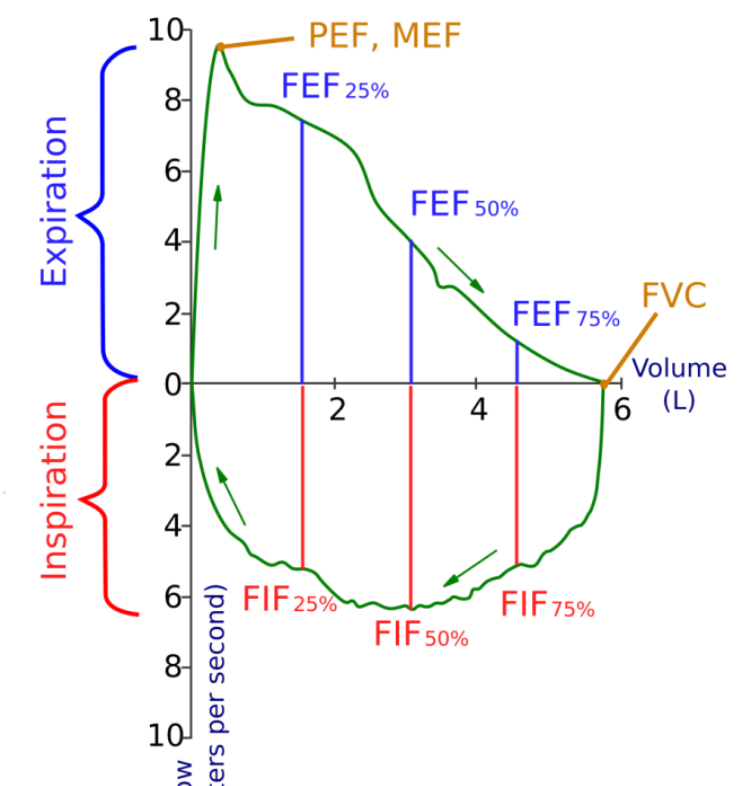
Diagram in text
The original PDF clips part of the vertical axis label where the next section begins; the crop preserves that source limitation.
The original green loop plots flow (litres per second) vertically against volume (L) horizontally. Expiration is above zero; inspiration is below zero. Arrows mark the direction around the loop.
- Expiratory peak: PEF, MEF.
- Expiratory flow labels: FEF₂₅%, FEF₅₀%, FEF₇₅%.
- Inspiratory flow labels: FIF₂₅%, FIF₅₀%, FIF₇₅%.
- End of expiration on the volume axis: FVC.
- Printed axis ticks: volume 2, 4, 6 L; flow 0, 2, 4, 6, 8, 10 above and below zero (the inspiratory side prints magnitudes without minus signs).
Interpretation
- PFT interpreted based on the shape of the loop, FEV1, FVC, and FEV1/FVC
- Obstructive lung disease
- Etiology – asthma, COPD, CF, bronchiolitis
- Shape of the loop – scooped loop
- Decreased FEV1/FVC < 0.75
- FEV1 decreased - >70% = mild, 50% - 70% = moderate, <50% = severe
- If FEV1 improves 12% or 200mL with SABA this is consistent with reversible airways disease (asthma)
- If FEV1 does not improve 12% or 200mL this is consistent with irreversible airway obstruction (COPD)
- Restrictive lung disease
- Etiology –IPF, pleural disease, neuromuscular disease, chest wall disease
- Shape of the loop – tall, peaked and narrow loop
- FEV1/FVC is normal, FVC is low , TLC is low
- FVC > 70 % = mild, FVC 50% - 70% = moderate, FVC <50% = severe
References
Original Respirology reference list. The source provides references for the specialty as a whole.