Approach to Shock
Approach diagram
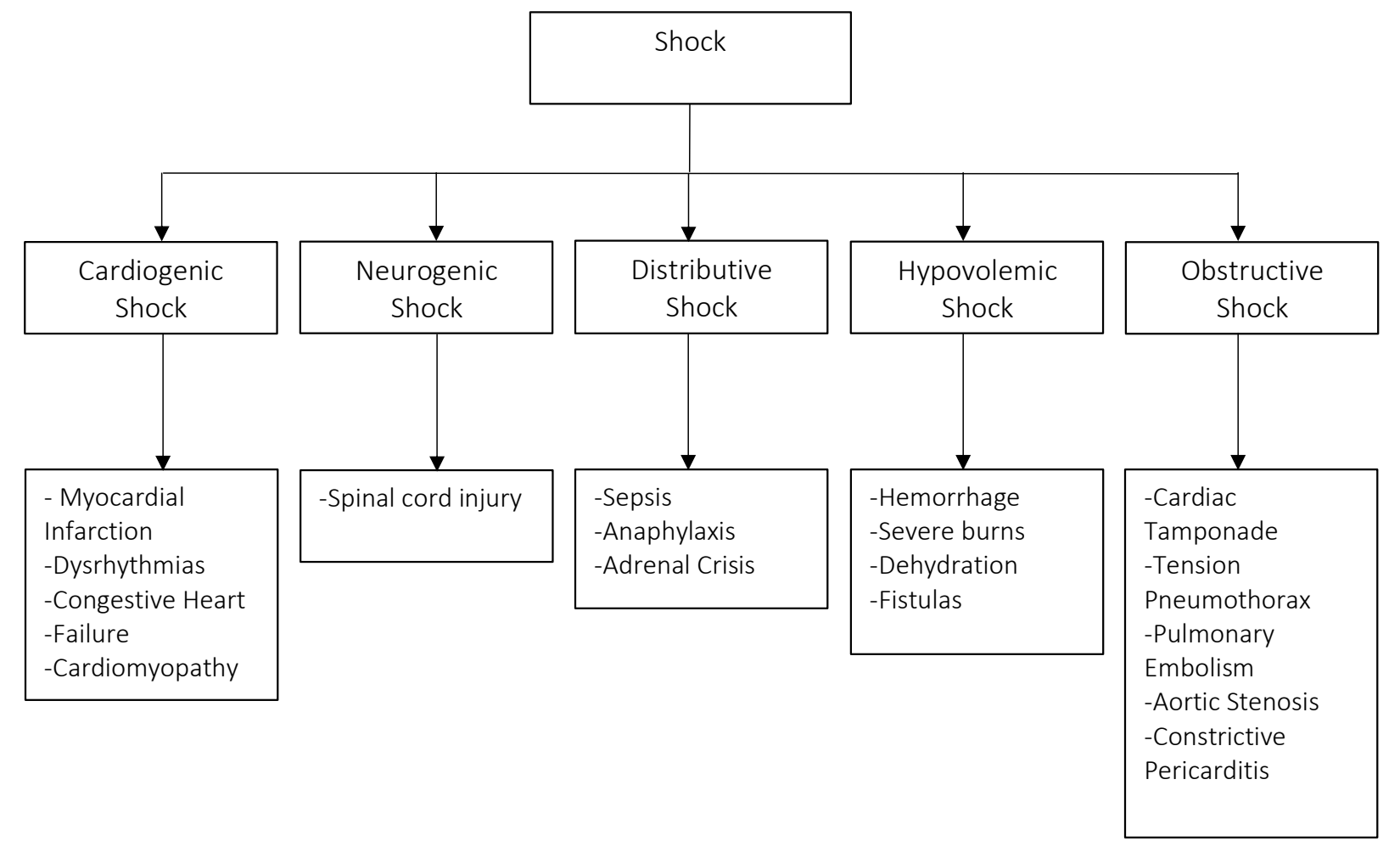
Diagram in text
- Cardiogenic Shock
- Myocardial Infarction
- Dysrhythmias
- Congestive Heart Failure
- Cardiomyopathy
- Neurogenic Shock
- Spinal cord injury
- Distributive Shock
- Sepsis
- Anaphylaxis
- Adrenal Crisis
- Hypovolemic Shock
- Hemorrhage
- Severe burns
- Dehydration
- Fistulas
- Obstructive Shock
- Cardiac Tamponade
- Tension Pneumothorax
- Pulmonary Embolism
- Aortic Stenosis
- Constrictive Pericarditis
Definition
Tissue hypoxia from decreased tissue perfusion from either decreased oxygen delivery, increased oxygen consumption or inadequate oxygen utilization.
SVR = systemic vascular resistance, CO = cardiac output, JVP = jugular venous pressure, HR = heart rate.
Cardiogenic
Definition: Failure of the heart to pump adequate amount of blood to the body. ↑SVR, ↓CO, ↑JVP, ↑HR.
Symptoms
- Confusion, shortness of breath, chest pain, leg swelling, nausea, vomiting, sweating
Signs
- Decreased BP, orthostatic hypotension, tachycardia, tachypnea
- Cool extremities, ALOC, decreased cap refill, mottling
Investigations
- CBC, electrolytes, BUN, Cr, liver enzymes, ABG, lactate, INR, PTT
- CXR, ECG
Neurogenic
Definition: Interruption of sympathetic nervous system causing unopposed parasympathetic nervous system. ↓SVR, ~CO, ↓JVP, ↓HR.
Symptoms
- Trauma or history of spinal cord injury
- May have paralysis below the level of the injury
Signs
- BP <90 mmHg or drop of 40 mmHg, bradycardia
- WARM extremities
- Neurological deficit below the level of the injury
Investigations
- CBC, electrolytes, BUN, Cr, liver enzymes, ABG, lactate, INR, PTT, FDP
- CT scan of the spine
- MRI if neurological deficit
Distributive - Sepsis
Definition: Systemic vasodilation. ↓SVR, ~CO, ↓JVP, ↑HR.
Symptoms
- Focal infectious symptoms (meningitis, pneumonia, cellulitis, arthritis, abdominal/CVA tenderness)
Signs
- SIRS criteria (2 of the following): 38 < T < 36, 14 < WBC < 4, HR >90, RR >20 or PaCO₂ <32
- Septic shock if circulatory abnormalities or lactate >2 despite resuscitation
Source note: The temperature and WBC inequalities above are printed in that order on page 13. They have been preserved rather than corrected.
Investigations
- CBC, electrolytes, BUN, Cr, liver enzymes, ABG, lactate, INR, PTT
- Blood cultures, urinalysis, urine culture, wound cultures, line cultures
- CXR
Hypovolemic
Definition: Decreased intravascular volume. ↑SVR, ↓CO, ↓JVP, ↑HR.
Symptoms
- Blood loss, fluid losses or decreased PO intake
Signs
- Hypotension, tachycardia, tachypnea, narrow pulse pressure
- Decreased cap refill, cool extremities, reduced urine output, altered LOC
Investigations
- CBC, electrolytes, BUN, Cr, liver enzymes, ABG, lactate, INR, PTT
Obstructive
Definition: Obstruction of blood out of the heart. ↑SVR, ↓CO, ↑JVP, ↑HR.
Symptoms
- Confusion, shortness of breath, chest pain
Signs
- Hypotension, tachycardia, tachypnea
- Decreased cap refill, cool extremities, altered LOC, peripheral edema
Investigations
- CBC, electrolytes, BUN, Cr, liver enzymes, ABG, lactate, INR, PTT
- CXR, ECG
Additional Information - Shock Management
General
- Treatment targets for shock
- Vitals: MAP >65, CVP 8–12 mmHg
- Urine output >0.5 cc/kg/hr
- Lactate <2
- ABCs
- Supplement O₂ +/- intubation
- IV access with 2 large bore IVs
- Vasopressors
- Consider if MAP <65, CVP <8–12 mmHg and UOP <0.5 despite 2 L of IV fluids
Cardiogenic
- General management
- IV fluid resuscitation
- 500 cc NS bolus unless in HF
- Additional considerations for vasopressors
- If MAP <65, CO low and SVR high can temporize with vasopressors (norepinephrine or dopamine) and consider inotropes (dobutamine)
- If MAP ≥65, CO low and SVR high start inotropes (dobutamine) and if SVR remains high consider vasodilators (nitroglycerin or nitroprusside)
- Consult cardiology/cardiac care unit
Neurogenic
- General management
- IV fluid resuscitation
- 1–2 L crystalloid bolus
- Additional considerations
- Atropine for bradycardia
Distributive (sepsis)
- General management
- IV fluid resuscitation
- 1–2 L crystalloid bolus
- Additional considerations
- Rapid administration of broad spectrum antibiotics
- Consult ICU
Hypovolemic
- General management
- IV fluid resuscitation
- 1–2 L crystalloid bolus
- Additional considerations
- Apply pressure on external wounds and elevate
- If continual bleeding and no response to crystalloids consider pRBC transfusion.
- Use FFP, TXA and platelets early in bleeding (pRBC:PLT:FFP, 1:1:1)
Obstructive
- General management
- IV fluid resuscitation
- 500 cc NS bolus unless in HF
- Treat underlying cause
Related notes and references
Acute Coronary Syndrome · Congestive Heart Failure · Original Cardiology reference list