Approach to Abnormal Hemostasis
Approach diagram
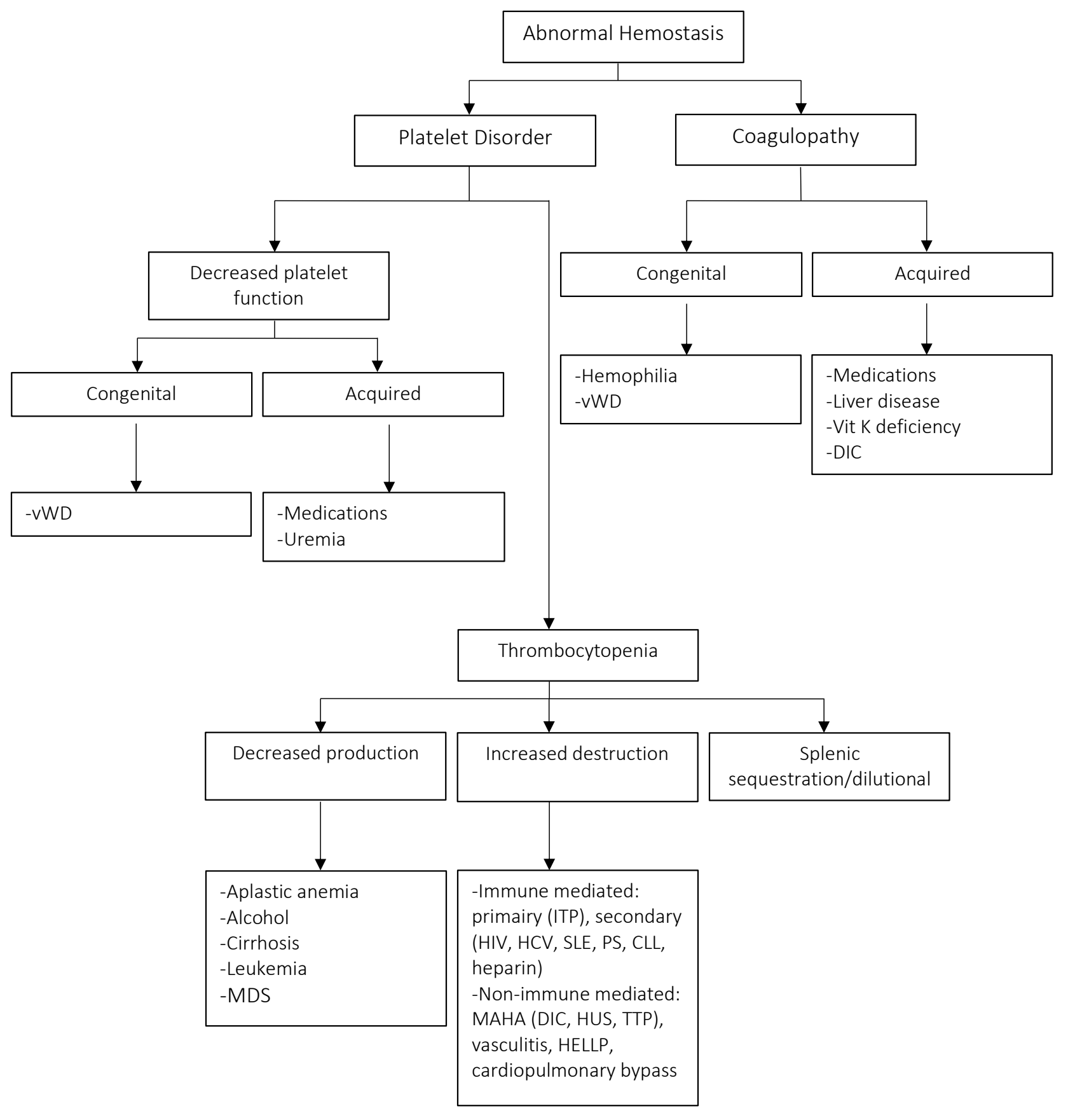
Diagram in text
- Platelet disorder
- Decreased platelet function
- Congenital: vWD.
- Acquired: medications; uremia.
- Thrombocytopenia
- Decreased production: aplastic anemia; alcohol; cirrhosis; leukemia; MDS.
- Increased destruction:
- Immune mediated: primairy (ITP), secondary (HIV, HCV, SLE, PS, CLL, heparin).
- Non-immune mediated: MAHA (DIC, HUS, TTP), vasculitis, HELLP, cardiopulmonary bypass.
- Splenic sequestration/dilutional.
- Coagulopathy
- Congenital: hemophilia; vWD.
- Acquired: medications; liver disease; Vit K deficiency; DIC.
Background
“ The clotting process is a dynamic, highly interwoven array of multiple processes. Different phases include: endothelial injury and formation of platelet plug > propagation of the clotting process by the coagulation cascade > termination of clotting by antithrombotic control mechanisms > removal of the clot by fibrinolysis.”
Definitions
- Immune mediated thrombocytopenia (ITP) – immune mediated destruction of platelets due to antiplatelet autoantibodies
- Thrombotic thrombocytopenic purpura (TTP) – vascular occlusive disorder characterized by thrombocytopenia, microangiopathic hemolytic anemia, change in mental status, fever renal failure
- Disseminated intravascular coagulation (DIC) – activation of coagulation from trauma, shock, infection, malignancy, obstetrics, leading to thrombosis and acute consumption of coagulation factors and platelets which leads to bleeding
- Von Willebrand’s disease (vWD) – quantitative (type 1) or qualitative (type 2) deficiency in vWF which acts as platelet “glue” and carrier for factor VII
Symptoms
- General – Medications (ex. Blood thinners, anti-platelets), alcohol use, recent infections, history of malignancy, constitutional symptoms, liver disease, autoimmune disease, family history of bleeding disorders
- Coagulopathy
- Deep and soft tissue bleeding (ex. Bleeding of joints, muscles, etc.)
- Delayed and severe bleeding after surgery
- Platelet disorders
- Skin and mucus membranes bleeding (ex. Gum bleeding, nose bleeds)
- Prolonged bleeding after mild cuts
- Immediate and mild bleeding after surgery
Signs
- General – Rule out active bleeding, splenomegaly, lymph nodes, signs of liver disease and autoimmune disease
- Coagulopathy – Hemarthroses, hematomas
- Platelet disorders – Petechiae, ecchymoses
Investigations
Platelet disorders
Thrombocytopenia
- CBC w/ differential
- Peripheral smear
- Increased destruction → look for large platelets, schistocytes (DIC, TTP, HUS)
- Decreased production → look for blasts, hypersegmented PMNs, leukoerythroblastic (aplastic anemia, MDS, leukemia)
- Additional laboratory investigations as indicated: reticulocyte count, LDH, haptoglobin, bilirubin, INR, PTT, fibrinogen, D-Dimer, Coombs, ANA, APLA, flow cytometry, viral titres
- Bone marrow biopsy – for unexplained thrombocytopenia
Disorders of platelet function
- To test platelet function - platelet aggregation test
- To test for Von Willebrand’s disease - vWF:Ag, vWF activity, factor VIII, vWF multimer analysis –
Coagulopathies
- PT, INR, mixing study, coagulation factor levels
- If DIC suspected – fibrinogen, FDPs, d-dimer
| Condition | PT | PTT | Factor deficiency |
|---|---|---|---|
| Hemophilia A | Normal | Increased | VIII |
| Hemophilia B | Normal | Increased | IX |
| DIC | Increased | Increased | Fibrinogen |
| Liver disease | Increased | Normal | All low except VIII |
| Vitamin K deficiency | Increased | Normal | II, VII, IX, X, protein C and S |
Management
Platelet disorders
- ITP→ steroids and IVIg. Splenectomy, rituximab, romiplostim if refractory.
- TTP/HUS→ urgent plasma exchange +/- glucocorticoids
- vWD → desmopressin (dDAVP), vWF replacement (cryoprecipitate)
- Uremia → dDAVP, cryoprecipitate, correct anemia
Coagulopathy
- Hemophilia A → purified/recombinant factor VIII, dDAVP if mild, cryoprecipitate, amino-caproic acid
- Hemophilia B→ purified/recombinant factor IX
- DIC→ support with fresh frozen plasma, cryoprecipitate, platlets
Source note: The definition on p. 66 calls vWF a carrier for factor VII, while the investigations and treatment refer to VIII. The definition is retained as printed; this discrepancy needs clinical review.
References
Original Hematology reference list. The source provides references for the specialty as a whole.