Approach to Hyperkalemia
Approach diagram
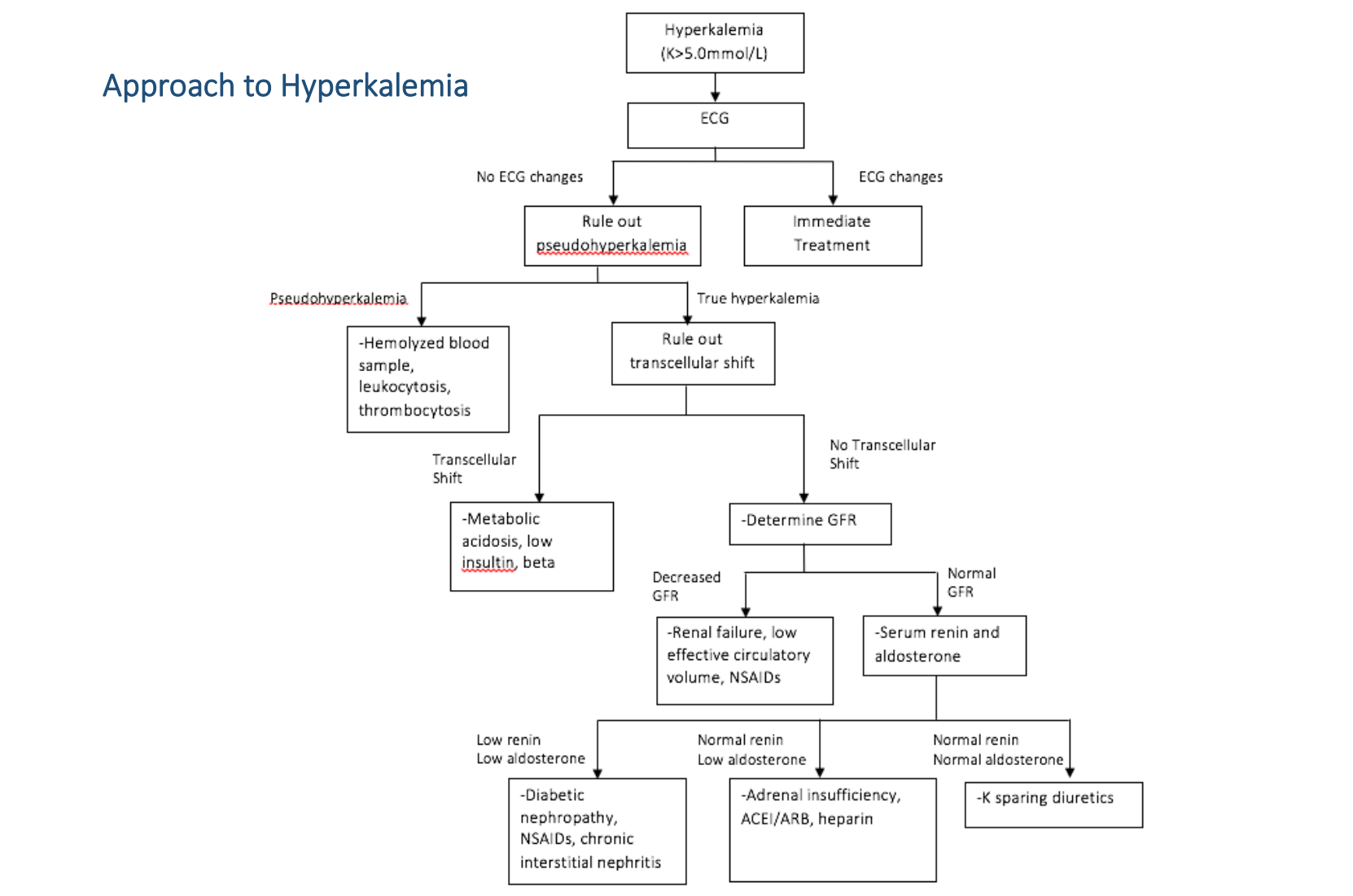
Diagram in text
Hyperkalemia (K >5.0 mmol/L) → ECG
- ECG changes: immediate treatment.
- No ECG changes: rule out pseudohyperkalemia.
- Pseudohyperkalemia → hemolyzed blood sample, leukocytosis, thrombocytosis.
- True hyperkalemia → rule out transcellular shift.
- Transcellular shift → metabolic acidosis, low insulin, beta.
- No transcellular shift → determine GFR.
- Decreased GFR → renal failure, low effective circulatory volume, NSAIDs.
- Normal GFR → serum renin and aldosterone:
- Low renin, low aldosterone → diabetic nephropathy, NSAIDs, chronic interstitial nephritis.
- Normal renin, low aldosterone → adrenal insufficiency, ACEI/ARB, heparin.
- Normal renin, normal aldosterone → K sparing diuretics.
Source note: The transcellular-shift box ends at “beta” in the original image; no missing term has been inferred. The source diagram is image-only and has no recoverable continuation in its text layer.
Symptoms
- Asymptomatic when mild
- General – nausea, hypoventilation
- Muscular – Weakness, stiffness, ascending paralysis, paresthesia
- Cardiac – palpitations
Signs
- ECG changes – peaked Ts >widened QRS > increased PR interval> wide and flat P wave > sine wave > VF/PEA
Management
- Emergent treatment if K+ > 6.0 and/or ECG and/or symptoms
- Calcium gluconate 1-2 amps IV – cardiac stabilization
- Shift K into cells (temporary measure)
- Regular insulin 10 U IV, need to order 1 amp D50W and glucoscans q1h x4
- Sodium bicarbonate 1 amp IV
- Excrete K
- Insert foley catheter to monitor urine output
- If hypovolemic give IV Normal Saline
- If hypervolemic give IV Furosemide
- If no urine output despite treatment, then consider hemodialysis
References
Original Nephrology reference list. The source provides references for the specialty as a whole.