Approach to Glomerular Disease
Approach diagram
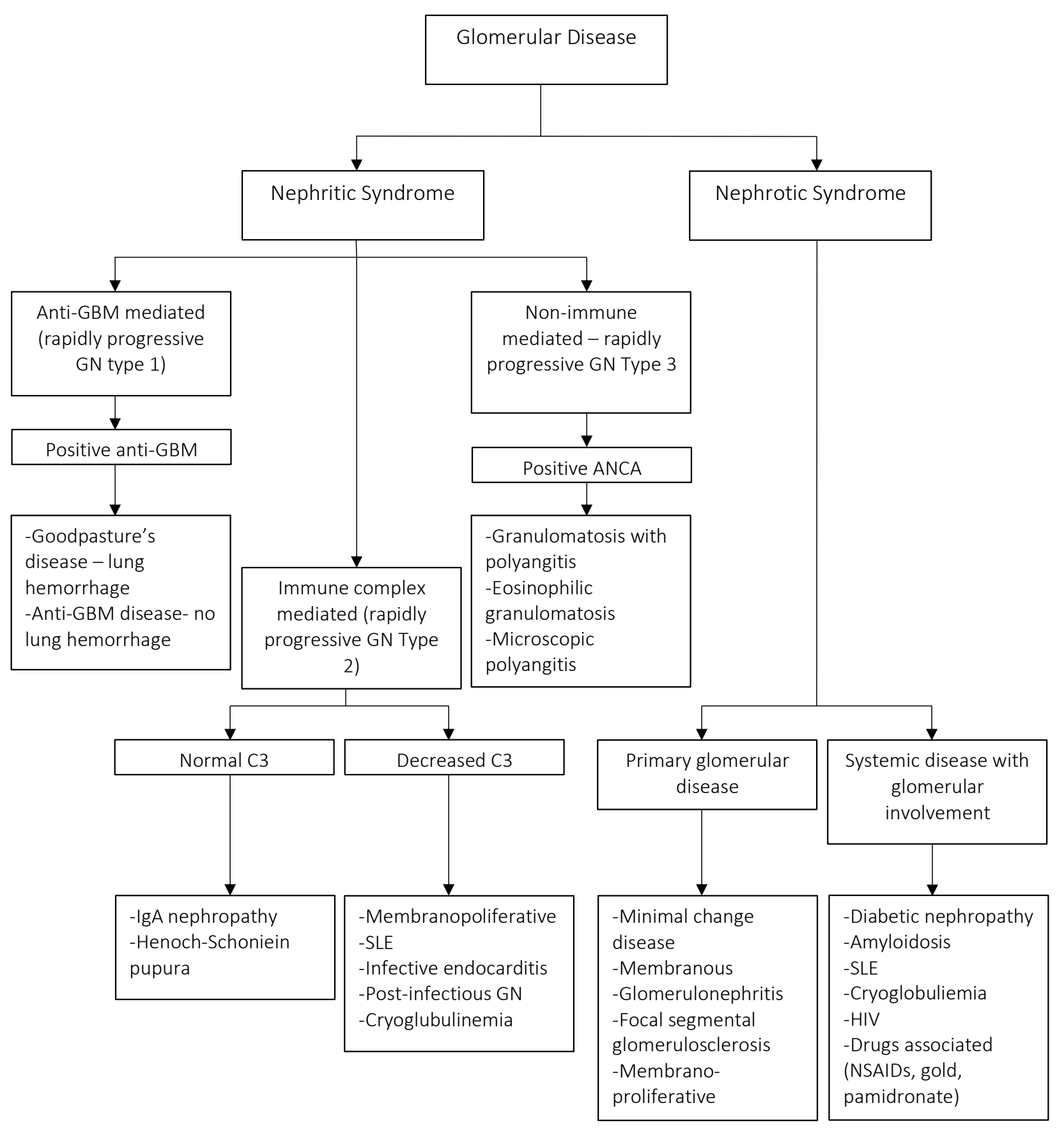
Diagram in text
- Nephritic syndrome
- Anti-GBM mediated (rapidly progressive GN type 1) → positive anti-GBM
- Goodpasture’s disease — lung hemorrhage.
- Anti-GBM disease — no lung hemorrhage.
- Immune complex mediated (rapidly progressive GN type 2)
- Normal C3: IgA nephropathy; Henoch-Schoniein pupura.
- Decreased C3: membranoproliferative; SLE; infective endocarditis; post-infectious GN; cryoglubulinemia.
- Non-immune mediated — rapidly progressive GN type 3 → positive ANCA
- Granulomatosis with polyangitis; eosinophilic granulomatosis; microscopic polyangitis.
- Nephrotic syndrome
- Primary glomerular disease: minimal change disease; membranous; glomerulonephritis; focal segmental glomerulosclerosis; membrano-proliferative.
- Systemic disease with glomerular involvement: diabetic nephropathy; amyloidosis; SLE; cryoglobuliemia; HIV; drugs associated (NSAIDs, gold, pamidronate).
Definitions
- Nephrotic syndrome
- Pathologically: abnormal glomerular podocyte permeability to protein
- Clinically: proteinuria >3.5 g/d, albumin < 35 g/L, edema, dyslipidemia, hypertension, thrombosis
- Glomerulonephritis/ Nephritic syndrome
- Pathologically: intraglomerular inflammation which can be focal or diffuse
- Clinically: hematuria with dysmorphic RBCs or RBC casts, may have subnephrotic proteinuria often with AKI, HTN, edema
- Acute GN progresses in days, rapidly progressive GN (RPGN) progresses over weeks, chronic GN occurs over months and may not progress, may simply have asymptomatic hematuria
!!! info "Additional information — Investigations and management" ## Investigations
### Nephrotic Syndrome

- Bloodwork – CBC, electrolytes, urea, Cr, albumin, lipids (Low serum albumin and high serum lipids)
- Urinalysis – hyaline casts, lipid droplets (oval fat bodies)
- Measure proteinuria – 24h urine collection, urine alblumin/Cr ration and protein/Cr ratio (proteinuria >3.5g/d)
- Investigate for secondary causes
    - Increased HbA1C + retinopathy → suggests diabetic nephropathy likely
    - ANA, anti-dsDNA, C3/C4 – autoimmune causes
    - Serum protein electrophoresis, urine protein electrophoresis, HIV serology

### Nephritic Syndrome

- Bloodwork – CBC, electrolytes, urea, Cr, Ck, uric acid (Increased Cr and urea)
- Urinalysis – RBC casts, dysmorphic RBCs, hematuria
- Investigate for secondary causes
    - Anti-GBM – positive in anti-GBM mediated GN
    - ANA, anti dsDNA, ENA, p ANCA, c ANCA – positive in non-immune mediated GN
    - C3, C4 – complements low in immune complex mediated GN except for IGA nephropathy
    - ASO titer – post-streptococcoal GN
    - HBV, HCV serology
    - Cryoglobulin – positive in cryoglobulinemia
- Quantitative Ig, serum protein electrophoresis

### Additional Investigations

- Renal Ultrasound or CT – Rule out obstruction and evaluate kidney size and hydronephrosis
- Renal biopsy

## Management


### Nephrotic Syndrome

- General – Sodium restriction, protein supplements, diuretics for edema, treat hyperlipidemia, BP control
- ACE inhibitor or ARB - Decrease proteinuria and slow progression of renal disease –
- Primary glomerular disease – Steroids or cyclophosphamide
- Anticoagulation if high risk for thrombosis

### Nephritic Syndrome

- Acute GN – methylprednisone IV for 3 days
- SLE GN – steroids and cyclophosphamides
- ANCA + GN or anti-GBM GN – pulse steroids and cyclophosphamides +/- plasma exchange
References
Original Nephrology reference list. The source provides references for the specialty as a whole.